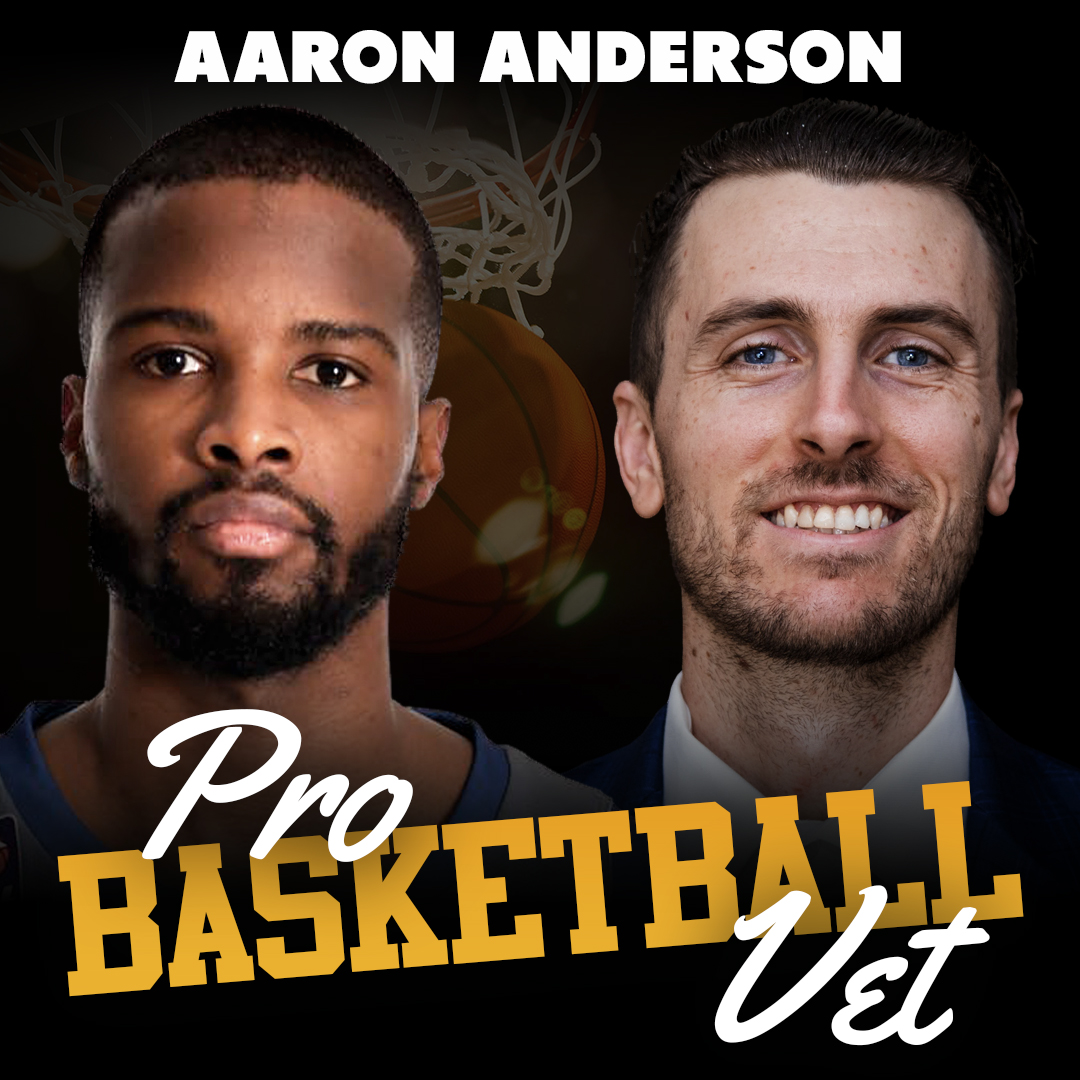
Aaron Anderson is a professional basketball player who last suited up for the French club Kaysersberg during the 2022-23 season.
Hailing from Brooklyn Park, Minnesota, from a young age the precocious Anderson possessed an innate ability to shine on the basketball court, often finding his rhythm hooping with friends, or learning from his father.
“A lot of the people I went to school with lived close to me, so we would play basketball at the park,” Anderson recalls.
“I also played in front of my house with my dad. That was a fun time.”
Outdoor basketball may be nostalgic for Anderson, but by the second grade he was wowing gymnasiums around the Twin Cities with his pinpoint passes and smooth jumper, to the point that many predicted Anderson could one day don a basketball uniform at the collegiate and professional levels.
“Growing up, I was better than a lot of the other kids, and as I got older that trend continued and I developed more confidence,” notes Anderson, who spent two years at Hopkins High School before transferring to neighboring Osseo for his latter two years.
There were many shining moments throughout Anderson’s illustrious high school career, but as a junior, Anderson and his childhood friend D.J. Phillips propelled Osseo all the way to the state championship game.
There, Osseo faced off against Hopkins, Anderson’s former school, who was led by future NBA player Royce White.
Tragically, Anderson and Phillip’s historic run ended that night with a loss to Hopkins, but many college scouts who were in attendance got a chance to see Anderson play a vital role in Osseo’s trek to the final.

The next fall, after having received a bevy of scholarship offers from universities around the country, Anderson elected to sign with the University of North Dakota.
At the time, North Dakota was transitioning into becoming a full-fledged Division-I program, and Anderson was excited about being a staple in North Dakota’s potential rise to prominence.
“My freshman year was their first year of Division-I play,” Anderson says.
“That gave me an opportunity to help lay the foundation for the program’s future success.”
For the next four years, Anderson guided the Fighting Sioux through the rigors of the college basketball season.
A three-year starter who routinely averaged double figures in scoring and shot over 40% from deep, each postseason the Fighting Sioux found themselves clawing out victories amid the madness that ensues each March.
“Every year, my teammates and I made it to the postseason, and we played in the CIT [collegeinsider.com tournament) because we were ineligible for the NCAA tournament,” Anderson says.
Despite averaging 10.6 points per game and shooting 40.5% from downtown, all while logging nearly 30 minutes each night, professional basketball opportunities didn’t immediately appear for the Brooklyn Park native after he graduated.
“Agents were telling me I had the talent to play at the next level and go overseas,” Anderson says, but he was also skeptical about emotionally investing in promises that could go unrealized.
“In a sense, the agents were telling me what I wanted to hear because they wanted to sign me, and while I was flattered, their approach wasn’t completely transparent, meaning they weren’t telling me the whole truth.”
Navigating the murky waters that come with being a free agent was challenging for Anderson, but he eventually signed with an agent.
At that point though, things came to a standstill.
“I kept reaching out to my agent, and he kept telling me he was going to get me into different leagues, but meanwhile I was sitting at home and waiting, and not hearing back from any teams,” Anderson shares.
Months continued to pass, summer turned to fall, and finally, Anderson could no longer sit idly while his basketball future was left in the hands of someone else.
“I got rid of my agent and subscribed to the eurobasket.com website. I got a list of all the coaches and agents in every country, and I started sending out highlight films to them,” he explains.
Anderson’s new approach didn’t immediately yield encouraging results, but six months later, while eating lunch at Dairy Queen, his phone rang.
“I finally got a response from a team in Australia,” Anderson remarks.
“They were really interested, and they wanted me to come out.”
That crucial phone call led to Anderson landing in Brisbane, a city with two million people that is known more for its revered Ancient Rainforest than it is for attracting top-flight basketball talent.
But Anderson’s perseverance not only soon got his name inked onto a professional contract.
It also led to a near-decade run as a professional basketball player, a journey that has taken him around the globe, but also challenged him mentally and physically, and given him the perspective to better understand just who he is.
“I played in Australia and England, so there wasn’t a language barrier, but when I was in France and Kosovo, I didn’t speak the language, and you learn a lot about yourself when you can’t talk to anybody and you’re also going through a culture shock,” Anderson reveals.
“Dealing not only with that, but then on the basketball side of things there were times where I wasn’t getting opportunities to play at the highest level, and that took a toll on me mentally as well. I started asking myself if I was still playing because I loved the game of basketball, or if I was simply trying to prove something.”
Perhaps that question has still not been answered.
Today, at the tender age of 31, Anderson is at a crossroads in his career, his legs no longer as fresh as they used to be, but his elite level ballhandling and court vision is still evident.
Which is to say, even though he can still ball, Anderson has given serious consideration to walking away from the game.
Of course, the juncture Anderson has arrived at is not unique to just him.
In fact, it’s a stage many professional athletes find themselves encountering, particularly as life becomes more serious and individuals lose more and more of the innocence of their youth.
“I might play one more season in Australia, but as far as doing the Europe grind, I’m done with that,” says Anderson, whose last dance with the game of basketball may have already occurred.
“I mean, here’s the thing about professional basketball: there is a mental toll it takes on you, and being away from family, especially as people get older and pass away, that only becomes harder and harder to deal with as time goes by.”
In other words, the “r” word has crept into Anderson’s vernacular, thirty years earlier than when most Americans anticipate permanently leaving their vocation and moving onto something new.
At the same time, this moment is not one of pain or anguish.
Already Anderson and his younger brother have started a creative agency called One Goal Media, whose aim is to create short and long-form content for business owners and entrepreneurs.
Right now, One Goal Media affords Anderson a reprieve from hooping, but within a few months it may be a bona fide exit plan from the game.
“For the past eight offseasons, I worked as a trainer at Legacy Hoops [formerly 43 Hoops]. I did that because I wanted to share my knowledge of the game of basketball with the next generation, but I have no aspirations of getting into coaching or anything like that,” Anderson says.
“I’m happy with what I accomplished with basketball, and whether I play one more season or not, when the time comes for me to completely step away from the game, I’ll be ready, and I won’t have any regrets.” QS
**
Today’s post is sponsored by:
Graham Riley and his team at Maverrik North America help entrepreneurs and business owners increase their reach on LinkedIn, which in turn generates more revenue.
If you’re looking to expand your presence on LinkedIn, then get in touch with Graham today by clicking the link above, or by scanning the QR code in the accompanying image!
 quentinsuper.com