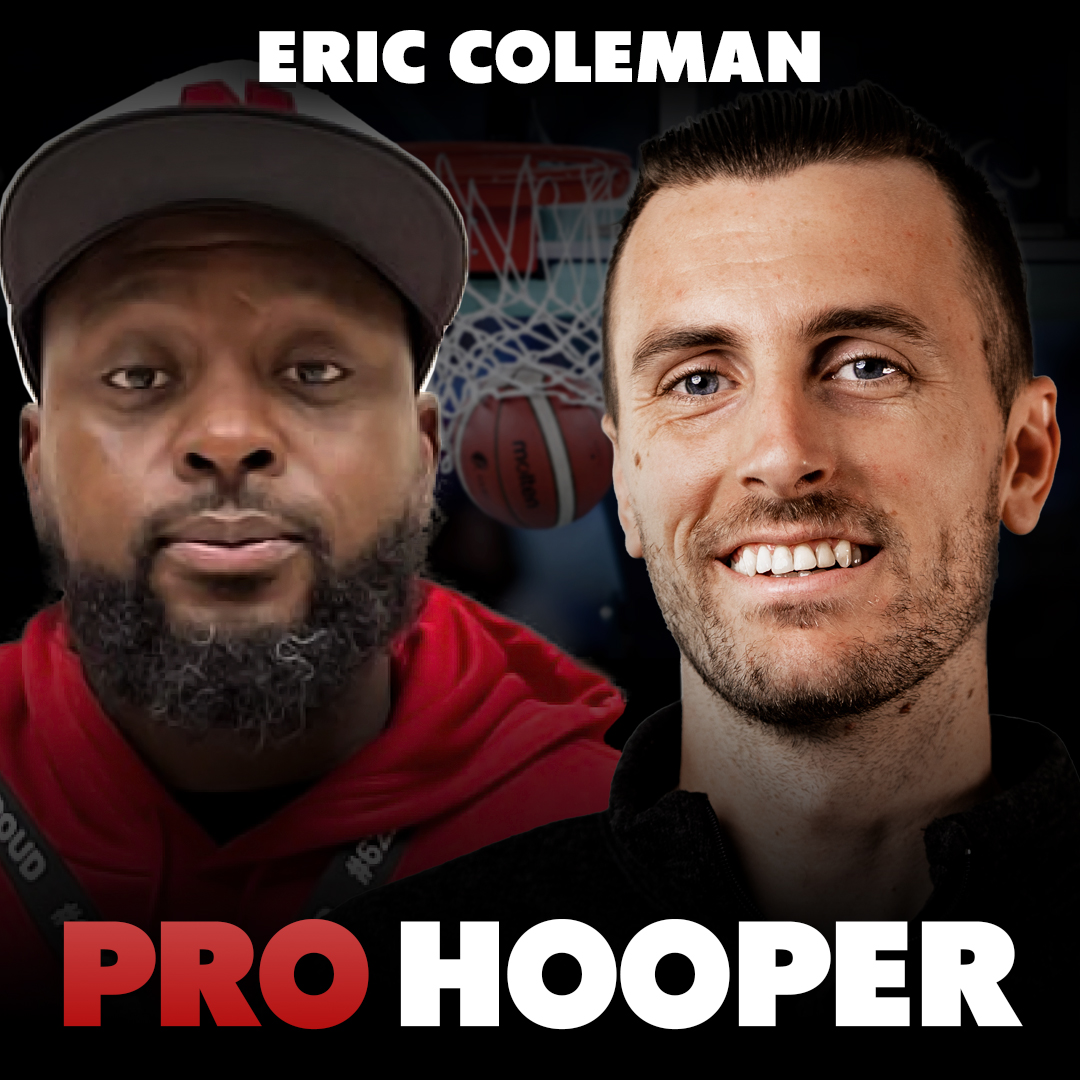
Eric Coleman is a former professional basketball player who is now a youth coach.
Originally from Kentucky, Coleman grew up in Owensboro, a tiny town two hours west of Louisville.
“It’s a little speck on the map,” Coleman says of his hometown.
“I loved it down there though. It taught me a lot of life lessons.”
In the eighth grade, Coleman left the state of Kentucky and headed north, surrounded by family but ultimately in search of more exposure for his blossoming basketball skills.
“Had I stayed there [Owensboro], I wouldn’t have been able to develop into the player I wanted to become,” the rugged big man shares.

Upon moving to the Twin Cities, Coleman enrolled at St. Paul Central.
“Didn’t have much luck there, academically,” he says, so his mom moved him to Tartan before his sophomore year.
In time, Coleman reversed course in the classroom, while simultaneously refining his post game, adding a buttery left hook to his already ferocious drop step that opponents felt square in their chests whenever Coleman imposed his will in the paint.
Tall and athletic, Coleman caused anxiety for Tartan’s adversaries, but despite his on-court dominance at the high school level, universities across the country opted not to pursue the big man.
“I didn’t think I was going to play Division-I,” Coleman admits.
“I honestly didn’t.”
Coaches at the next level lamented Coleman’s lack of height, believing that the 6-4 center would be overmatched by opposing bigs who had a few inches on him.
“In the Big Ten, you’re going up against someone who is 6-9 every night,” Coleman reminds readers.
“Because of my size, a lot of people didn’t think I could hang night in and night out.”
Collegiately, Coleman’s future was in flux, until the University of Northern Iowa, an annual Missouri Valley Conference title contender, entered the fray.
“They were on me the whole time, but they didn’t offer until late,” Coleman says, but alas, he had attracted a coveted athletic scholarship.
That fall, the overlooked Coleman paraded around campus with a massive yet dippable chip on his shoulder, eager to prove he belonged at the Division-I level.
“I was willing to run through a wall for Coach Mac [college coach],” Coleman says.
“He was the one guy willing to take a chance on me.”
Coach Mac’s faith was quickly rewarded.
In Coleman’s freshman season, he averaged over 10 points per game.
Later, between his sophomore and junior seasons, Coleman grew to 6-8.
“That number depends on if my shoes were on or not,” he says with a laugh.
Along with his stature, Coleman’s game equally ascended, those long offseasons in humid gyms resulting in double digit scoring campaigns in all four of his years at UNI.
“No one ever expected me to do much, but within the system I played my role and was able to thrive,” Coleman notes.
There is a lesson to be gleaned from Coleman’s collegiate journey, in that not every basketball player needs to attempt to mimic LeBron James in order to have an impact on the court.
“Understanding your role is the biggest thing as a player,” says Coleman, who routinely prioritized team over self, knowing full well the system would reward him for his selfless contributions.
“For someone to say that role players don’t get noticed is crazy. There are role players in the NBA who are getting $100 million contracts right now.”
After UNI, Coleman never inked a $100 million deal, nor did he don an NBA uniform, but he did play 16 years of professional basketball, simply because he had the IQ and EQ to match his natural talents.
“The higher the level of competition, the less you will be asked to do as a player,” says Coleman, further emphasizing the need for players to niche into their roles for the betterment of the squad.
“And that’s because teams at those upper echelons are looking for stars in their respective roles. They’re not looking to fill the roster with 15 different LeBron James.”
To a role player like myself who has never even sat on the bench of a college team, Coleman’s words make sense, but far too often, young hoopers are dismissing the notion of individual sacrifice so that the collective can win.
“We live in a highlight world,” Coleman responds when asked why that is the case.
“Everyone sees the spectacle, but they don’t see the boring but necessary work that goes into it.”
For a seasoned vet like Coleman, the work became the joy, and as the years passed and his mind continued to complement his physical gifts, basketball became blissful.
“The majority of the time, I wasn’t the best player on the team, but I was a star in my role. I was the best at what I did,” he explains.
“I always knew my time was going to come to shine, and I was willing to wait for it, knowing full well that there is enough basketball to go around.”
In that sense, a professional basketball player’s obstacles are as much mental as it is knocking down jumpers so that the guy behind you doesn’t nab your starting spot.
“You really have to challenge yourself every night,” Coleman remarks of the grind of pro hoops.
“Like, you are going against other pros every day, and that teaches you the importance of always playing hard because if you don’t, you could get embarrassed very easily.”
A few years ago, Coleman exited the hardwood, permanently, albeit voluntarily.
“I wasn’t plagued by injuries. I was just ready to move to the next phase of my life,” he says.
“I had done everything I wanted to do, basketball-wise.”
Having amassed countless championships and personal accolades, Coleman also was fortunate to visit as many countries as he has fingers, and there isn’t a state in the contiguous Americana where Coleman isn’t readily welcomed with open arms by a friend.
“That’s the beauty of basketball,” he says, but with his playing days over, Coleman is fully entrenched in the next era of his life, a period that is primarily comprised of giving back and disseminating the same knowledge he once inherited.
“These days are a lot quieter,” he says with that same congenial laugh that has endeared Coleman to so many people around the globe.
“Now I’m teaching kids how to get wide-open threes, and as much as I am in the business of basketball, I really love teaching kids the game. That’s my natural calling.” QS
**
Today’s post is sponsored by Tiffany Daly of WIIN Insurance Agency!
On the personal side, Tiffany writes policies for home, auto, and umbrella insurance.
For commercial insurance, WIIN writes policies for general liability, worker’s comp, commercial auto, umbrella, and cybersecurity.
Tiffany and WIIN are currently licensed in six states, including: Minnesota, Wisconsin, Florida, Arizona, North Dakota, and Oklahoma.
To receive your free insurance estimate, call Tiffany today at (612)505-3329!
 quentinsuper.com
Leave a comment