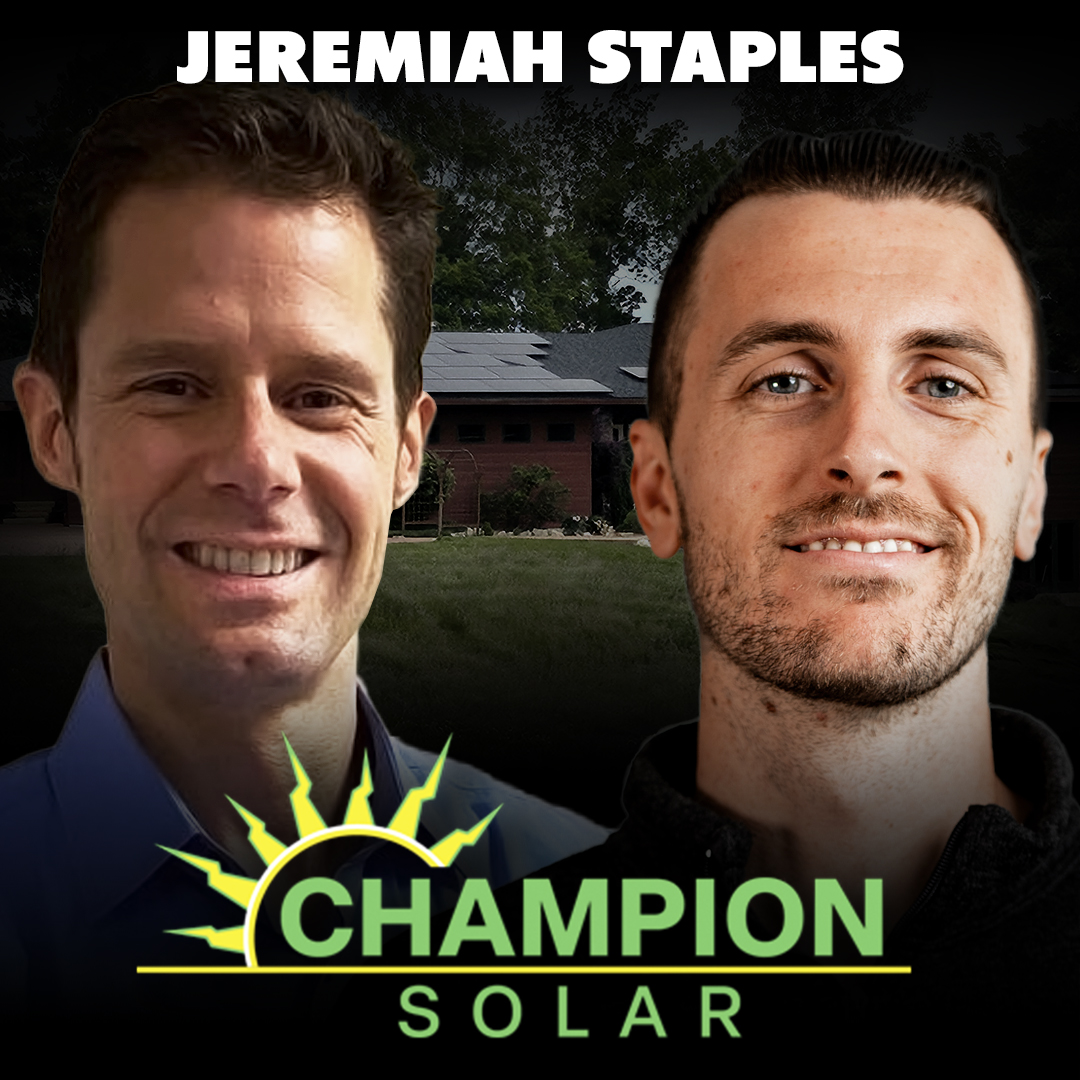
Jeremiah Staples is the owner of Champion Solar.
Raised near Duluth outside of Two Harbors, Staples enjoyed a quiet childhood.
“We lived out in the woods, and I was a super shy kid, so I loved it,” he recalls.
As a teenager, Staples liked sports that didn’t require a roster of players.
“I was more of an athlete on an individual level, meaning I did things like hiking, cycling, fishing, and hunting,” he says.
More introverted than extroverted, Staples thrived academically.

“If anything, school was very slow and boring,” says Staples, who from an early age charted a career path.
“I knew at age thirteen that I wanted to be a doctor.”
Staples did indeed add Dr. to his title, embarking on a path in chiropractic.
For the next two decades, Staples helped patients with an array of physical maladies, and in turn, he learned a lot, both about medicine, and business.
“Even a person like me, who is incredibly shy, can get out there and make things happen,” Staples says.
“Also, I discovered that just having a business is not enough to be successful. You have to love it and be passionate about it; and then you have to learn how to sell and market what it is that you do.”
In 2022, Staples left chiropractic and, along with his business partner Jon, purchased Champion Solar, a solar company that had been in operation since 2010.
Of course, Staples entered the solar industry because he saw the fiscal potential, but he also saw something more.
“This venture is about saving the world,” he says.
“As a chiropractor, I was helping one person at a time, and now I look at it as I’m able to help a lot more people.”
Adds Staples:
“I am a big tree-hugger, and I believe that we have to work harder at making the planet better than how we found it.”
There are some who see solar energy as a conduit to that global preservation, that perhaps when we turn on the lights in our kitchen, we don’t have to be burning coal to do so.
According to Staples, the process of turning coal into energy is both labor-intensive and expensive, and by switching to solar, homeowners can reduce their carbon footprint.
“In many ways, why go through the process of burning coal every day when you could instead put solar panels on your roof and have that system produce energy for the next 40-50 years?” Staples rhetorically asks.
“Oh, and that energy is free. You don’t have to dig up or burn something in order to get that energy.”
A cheaper energy bill?
Now that’s something most homeowners will warmly embrace.
“When I go over proposals with someone, if it’s not saving them tens of thousands of dollars over the course of twenty years, then solar might not be a good fit for them,” Staples acknowledges.
“I mean, it’s amazing how much money solar can save people over the long-term.”
Another way of looking at solar is that homeowners who install the panels on their roofs are taking control of their costs.
As for what kind of homes could benefit from solar panels being installed on their roofs, the criteria isn’t massive.
“Any home with a roof that is exposed to the sun,” Staples insists, before mentioning that any roof that is blanketed by trees or shade would not receive maximum value from an investment in solar.
“But we do install a lot of ground units as well, so even if someone has a shady roof, if they really want to have solar and all the benefits that come with it, we can accommodate that type of home,” Staples explains.
Solar, like electric vehicles, is quickly picking up momentum on the open market, but Staples says it’s common for prospective clients to be reticent about the large up-front cost, which on average is around $20,000.
“I often frame it like this: say someone is spending $200 per month on their energy bill. That bill will increase every year and go on forever. Well, with solar, your payment is often less than $200 for the same amount of energy (thus erasing the $200 to the utility company) and the payment is locked in, so it never increases. Also, there is an end date to the payment for solar, meaning the power is then free,” Staples explains.
“Also, in Minnesota, legally, the utility company has to pay you for any excess energy that you generate.”
Adds Staples:
“Our state is unique in that regard, because the bigger you build out your solar system, the more you will theoretically benefit, financially.”
Some things to consider with solar:
If your home has a roof that is around the 20-year mark, then it’s best to replace it before installing solar panels because your shingles will eventually degrade and need to be replaced, resulting in disassembling and then reinstalling the solar panels.
“If your roof has 3-5 years left, and you’re strongly considering solar, then it makes most sense to replace your roof now,” Staples observes.
“There is no way our company would ever recommend putting solar on a roof that age without making explicitly clear that we believe it’s in the homeowners best interest to replace the roof beforehand.”
Still, should a homeowner elect to install solar panels on an older roof, Staples estimates that to disassemble and reinstall will later cost them around $5,000.
Of note:
In the event that a hailstorm sweeps across Minnesota, solar panels reportedly are covered by insurance carriers (although Staples encourages homeowners to talk with their insurance agent and confirm as much).
“It’s nice, because as soon as the solar panels are attached to your house, it’s covered by insurance,” Staples says.
With so many companies entering the solar market, finding a reputable company may seem daunting, and that’s where Champion Solar strives to be different.
For context, all of their solar installers are licensed electricians, as mandated by the state of Minnesota.
“Minnesota is one of the only two states in the entire country that has this law,” Staples says.
This information is key because if someone knocks on your door and they represent a solar entity from out of state, it’s possible that that company’s installers aren’t properly licensed.
“Our company and our installers know all the rules, and they are professionals at what they do,” Staples emphasizes.
“For the record, our installers are not guys who normally wire houses. Rather, our installers specialize exclusively in solar.”
Also, Champion Solar sources many of their materials from American manufacturers.
“We don’t go with the cheapest materials that we can find,” Staples says, because when other solar companies buy in bulk from overseas in order to save money, the homeowner ultimately receives an inferior product.
“In those instances, the output from the materials is simply not as good,” Staples says.
“And I don’t know any homeowners who would be satisfied with a less than stellar output from their solar panels.”
Plus, when solar companies spend less on materials, the accompanying warranties are less comprehensive, and the solar systems themselves don’t last as long.
“The company that you hire to install solar panels on your home matters,” Staples reiterates.
“We get a lot of calls from clients who need service on their panels because the company they initially hired is no longer in business.”
Looking ahead, Champion Solar will continue to distinguish themselves by offering repair and warranty work.
“Sometimes people don’t even know why their solar isn’t producing as well as it can or once did, so we want to continue to be a trusted resource that they can rely on,” Staples says.
Champion Solar is also aiming to partner with more roofing contractors, the goal being to share their wealth of knowledge with companies who understand the nuances of shingles, but may need guidance when it comes to solar panels.
“As it relates to solar, roofing companies don’t necessarily have an in-house expert. We can be that expert,” Staples explains.
Plus, Champion Solar wants to make inroads in the commercial market.
“Two years ago, we were 80% residential. Last year we were 50-50,” Staples reveals.
”Commercial jobs are bigger, and they have a larger impact on communities and environments, and with how we have structured our business and our mission, we think we are uniquely qualified to help more property owners put solar on their commercial real estate.” QS
**
Today’s post is sponsored by Tiffany Daly of WIIN Insurance Agency!
On the personal side, Tiffany writes policies for home, auto, and umbrella insurance.
For commercial insurance, WIIN writes policies for general liability, worker’s comp, commercial auto, umbrella, and cybersecurity.
Tiffany and WIIN are currently licensed in six states, including: Minnesota, Wisconsin, Florida, Arizona, North Dakota, and Oklahoma.
To receive your free insurance estimate, call Tiffany today at (612)505-3329!
 quentinsuper.com
Leave a comment