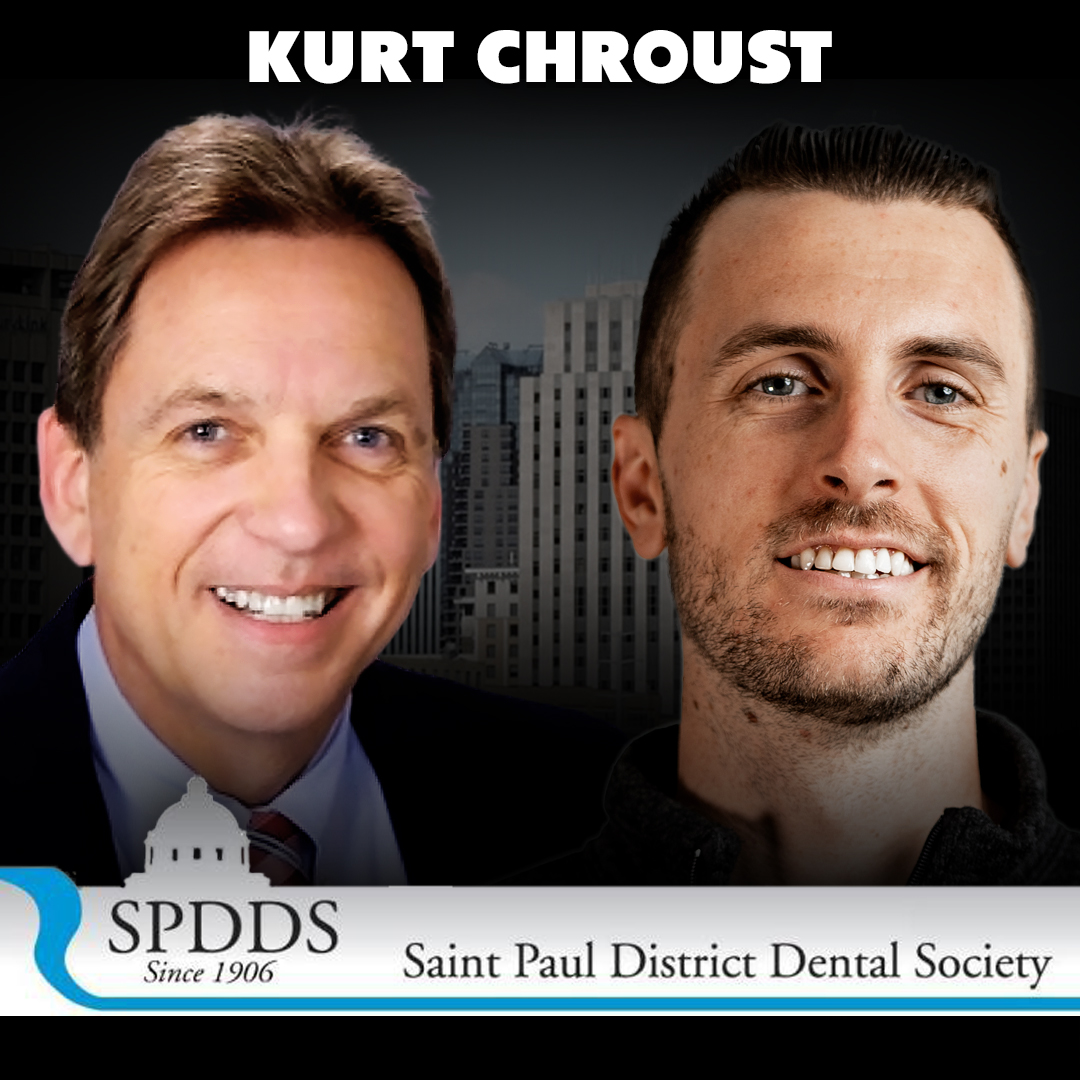
Kurt Chroust is a dentist and the president-elect of the St. Paul District Dental Society.
Originally from suburban Chicago, at age sixteen Chroust and his family headed west, to Cedar Rapids, Iowa.
A sports participant in high school, Chroust often warmed the bench during varsity play.
“They would put me in for the last couple minutes, assuming the outcome was already decided,” Chroust says with a laugh.
Off the court, Chroust recalls being an “okay” student, but that was enough to land him in Kenosha, Wisconsin, at Carthage College, where he studied biology.
“That’s also where I met Vicki [his wife],” he adds.

After graduating from Carthage, Chroust then returned to The Hawkeye State, enrolling in dentistry school at the University of Iowa.
“I wanted to go into healthcare, but I didn’t want to be an M.D.,” he notes of a career path that rivaled his older brother’s.
“Moreover, I wanted to run my own business, and with dentistry I could do that and have good hours.”
For context, I like going to the dentist, but as a kid, I abhorred the six-month checkups, going so far as to once bite my dentist’s thumb and draw the ire of my mother.
According to Chroust, both the child and present version of me are commonplace in dental offices.
“Like any business, it’s a mixed bag,” he says nonchalantly, having seen all types roll into his practice.
“There are people who love going to the dentist and getting their teeth cleaned. Those people want to know everything about their oral health, and they’re actually really good patients and great referral sources.”
Of course, what goes up must come down, so not all patients are as enthusiastic as the aforementioned.
“The average person is ambivalent about their teeth, meaning they’re not thrilled about going, but they know they have to be there,” Chroust mentions.
Then you have the woebegone patients whose oral health is more forgotten than what they had for breakfast several days prior.
“People like this, they might drive a Mercedes or a BMW and have their professional lives completely together, but they will only come to the dentist when their mouth is falling apart. It’s just not a priority for them,” Chroust explains.
“Actually, here is an analogy you can appreciate, Quentin: they will only replace the roof once it starts leaking.”
Avoiding painful dentist trips is possible, provided individuals are willing to prioritize daily maintenance of their prized teeth.
For starters, a diet devoid of sugar-riddled beverages and chewy candies is an excellent way to prolong the life of your molars.
“Sugar and pop kill teeth,” Chroust laments.
“I like to have a Coke from time to time, but if I’m going to have one, I try to drink it within a half hour and then go rinse my mouth out. You definitely do not want to sip on that stuff all day.”
Evading chocolate bars and Mountain Dew is prudent, but equally crucial is routine flossing and brushing (but not so hard that your gums recede).
Surprisingly, genetics also plays a role in oral health.
“Sometimes people inherit a predisposition to decay or gum disease,” Chroust points out.
“But that you can’t control, in the same way some people are more prone to heart disease.”
With 35 years of experience, it’s safe to say Chroust is a trusted source for oral health guidance, but when it came to running his practice, readers will be pleased to learn that sustainability has more to do with the golden rule than adopting the latest advancements in dental technology.
“What works in a dental office also works in a hardware store, at a roofing company, or in any business,” Chroust insists.
“And this is cliché, but I’m a huge believer in treating people how you would want to be treated.”
Chroust then doubles down on that sentiment as we sit in Eagan Lifetime’s revamped workspace, a morning of intense pickleball on the horizon.
“Being honest with people is key. They may not like the information you’re telling them, but most people eventually understand that you’re trying to help them,” the Hawkeye alum says.
“Again, they may not be happy with the information, but at least they’re not unhappy with you.”
Adds Chroust, ever so deftly:
“It’s easy to take care of patients when everything is going right and they are in good health, but when things aren’t going well and adversity hits, that’s when your true character stands out, and that’s what people remember.”
It should be mentioned that Chroust recently sold his business, his days of being at the dental office every day now over.
That being said, he still helps out at local dental offices who are in need.
“When I retired, I looked up twenty different offices that only had one doctor, and I cold-called them and said that I can help if they had any needs,” Chroust says.
“Six offices called back.”
Of note:
Chroust is also the president-elect of the St. Paul District Dental Society, an organization composed of dentists which promotes the oral health of the public, ethics, science, and the professional advancement of their members.
Essentially, it’s the promotion of organized dentistry.
“I don’t want that to sound like a negative thing because I think organized dentistry is there to serve dentists, their staff, and patients,” Chroust says.
Looking ahead, perhaps the biggest challenge awaiting Chroust and the dental society is the recruitment of young dentists into an industry that has dramatically changed since Chroust entered the profession decades ago.
“When I got out of dental school, we had 97 students, and three of them were females,” he observes.
“Today, more than 50% of the graduating classes are women.”
In that sense, dentistry is now more egalitarian, but it’s also become more corporatized as dentists join entities instead of starting their own practice.
“This becomes complex because the priority of the corporations are not necessarily the priorities of the ADA [American Dental Association],” Chroust says, exploring the dichotomy between business interests and scientific practice.
“We still believe there’s a value in the American Dental Association.”
Curious, I ask why.
“There is an old axiom: if you’re not at the table, you’re probably on the menu,” Chroust cleverly unveils.
“If you don’t have a voice at the federal or state level, there are probably going to be things that get passed that are not in your best interest as a dentist, which is why we want to have a larger voice, because we understand dentistry on a very nuanced level.” QS
**
Today’s post is sponsored by Tiffany Daly of WIIN Insurance Agency!
On the personal side, Tiffany writes policies for home, auto, and umbrella insurance.
For commercial insurance, WIIN writes policies for general liability, worker’s comp, commercial auto, umbrella, and cybersecurity.
Tiffany and WIIN are currently licensed in six states, including: Minnesota, Wisconsin, Florida, Arizona, North Dakota, and Oklahoma.
To receive your free insurance estimate, call Tiffany today at (612)505-3329!
 quentinsuper.com
Leave a comment