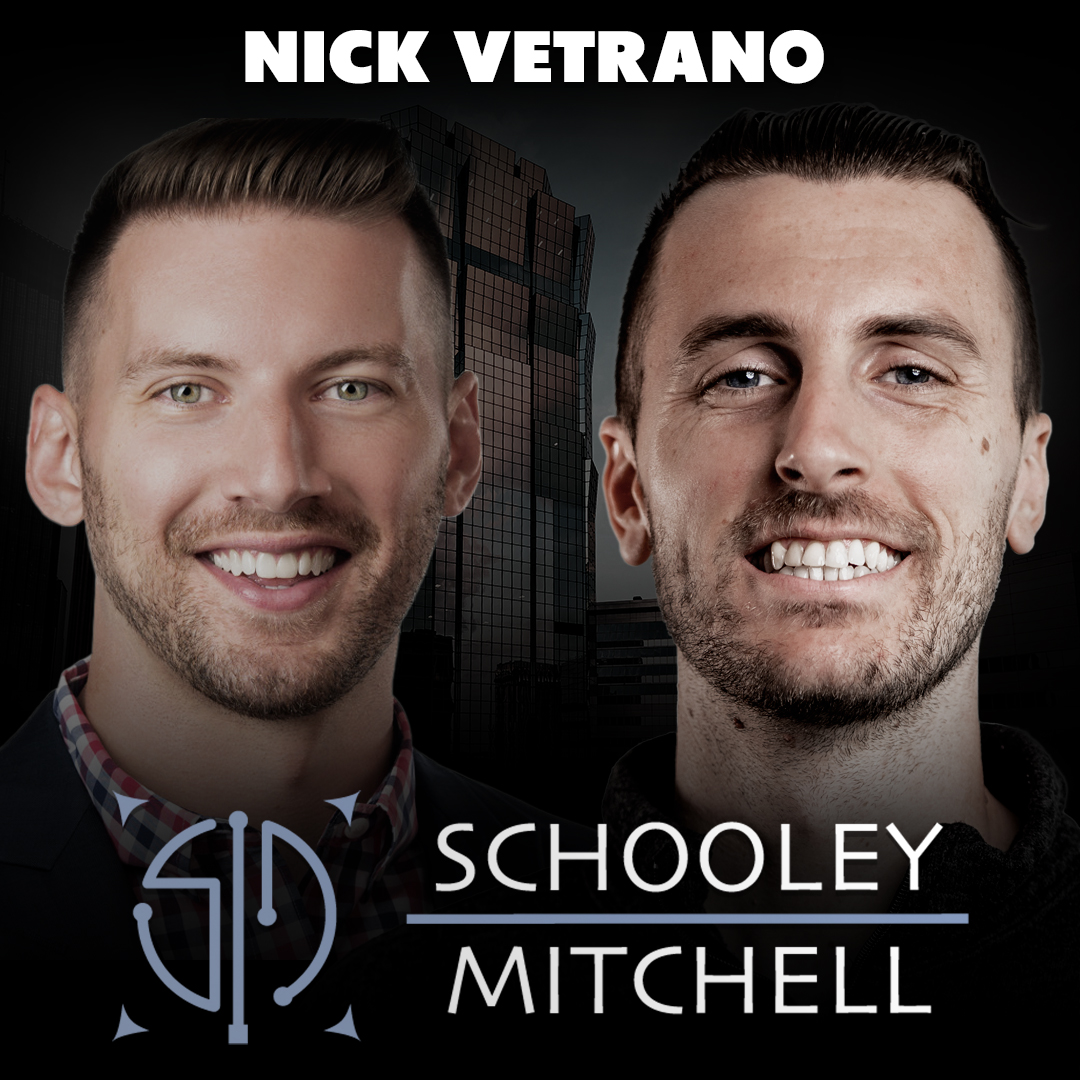
Nick Vetrano is a franchisee owner of Schooley Mitchell, and a cost reduction expert who helps organizations increase cash flow and profits through expense optimization.
Born in Fridley but raised in Buffalo, a quiet suburb located 45 minutes northwest of Minneapolis, Vetrano spent his youth playing sports and being amiable with his peers.
“I got along with everyone,” says Vetrano, who lettered in football, basketball, and lacrosse.
Post-high school, Vetrano left Minnesota and followed in his sister’s footsteps, enrolling at Northwood University, a business school two states over in Michigan.
“When I went to college, the goal was always to buy a business,” Vetrano shares.

After graduating college, Vetrano worked as a healthcare insurance salesman, devoting five years of his life to the industry before deciding to seek fulfillment elsewhere.
“With insurance, I built a book of business and enjoyed the process of client acquisition, but I wasn’t very passionate about the healthcare aspect of the business,” he admits, so he then pivoted and went to Sunbelt, where he sourced potential deals for the agency’s brokers.
“My goal with working at Sunbelt was not to stay there, but instead learn how to buy a business.”
In his quest to become an entrepreneur, Vetrano was looking to step into an industry that was recession-proof, so he considered operating a hair salon, or even a liquor store.
“I always wanted a business that could withstand the tumultuous nature of the economy, but around the time I was looking for businesses to buy, COVID happened, and I realized that a lot of other businesses are not COVID-proof,” Vetrano recalls.
“But around that time is also when I found Schooley Mitchell.”
For reference, Schooley Mitchell is a massive enterprise that specializes in helping other companies reduce their expenses, and in turn put more money back into their clients’s pockets.
“We save companies time and money by being a second set of eyes that can analyze their business expenses,” Vetrano affirms.
“We make sure that companies are not overpaying for the essential items they need in order to run their business.”
According to Vetrano, business owners are not oblivious to the fact that each month they might be allocating excessive capital to various expenses.
At the same time, it’s fair to say most companies don’t know where their resources are being misappropriated; only that too much money is escaping their purview.
“Quite frankly, that’s why Schooley Mitchell exists,” insists Vetrano, whose title may be cost reduction expert, but in many ways he’s a savvy consultant with the power to shore up a company’s financial pain points.
“Everything we save goes right to the company’s bottom line. In other words, we give companies pure profits.”
As for how business owners are missing out on saving money, Vetrano reiterates that it’s not fancy golf trips to Cancun or new office furniture that hampers companies.
Rather, it’s the everyday necessities that too often are glossed over on a spreadsheet due to their inherent importance.
“Many business owners overlook how much they’re spending on their cell phone bill or shipping costs because they know that they need those things,” Vetrano says.
“But if they’re not being diligent and analyzing how much those items and services are priced at, then they’re forgoing a lot of potential revenue that they simply don’t have to.”
At present, Vetrano’s client base consists of manufacturers, distribution centers, and government municipalities, although the Buffalo product is confident that Schooley Mitchell’s cost-saving strategies can assist most companies who produce a lot of volume.
“Really, we can help any business that spends money on telecoms, shipping, cell phones, garbage services, and credit card processing fees,” says Vetrano, but the best part of Schooley Mitchell’s value proposition is they don’t lock in their clients to expensive retainers in order to maintain their services.
In fact, it costs a business precisely $0 to have Vetrano and his team run diagnostics on a company’s expenses.
For context, Schooley Mitchell is only compensated when they save their clients money, and in those instances, they receive a percentage of the money their customers retain.
“There is no upfront cost or investment for the clients that we work with,“ Vetrano emphasizes, before taking a sip of the cold brew coffee that he has nursed throughout the course of our conversation.
“From a purely financial standpoint, there is no risk to working with me because I don’t get a penny if I don’t save my clients money.”
If anything, Vetrano and Schooley Mitchell absorb all the risk because they still need to pay their support staff that runs numbers and does the crucial investigative research that determines if their clients are spending too much money.
“We take this initial risk because that’s how much we believe that we can find ways to optimize a company’s expenses,” Vetrano says.
“I have no issue with getting paid on the backend, after we have delivered value.”
Adds Vetrano, in attempt to assuage the concerns of potential clients who believe they aren’t leaving any money on the proverbial table:
“Another element to this is that even when we do find businesses’ savings, they don’t have to take our recommendations. If a client wants to continue overpaying for certain things, for whatever reason, they are more than entitled to do so.”
Working off that, after Vetrano and his team run their internal analysis, one of two things occurs:
A business is shown where they’re spending too much money, at which point they can work with Schooley Mitchell to reduce those costs.
Or they can feel a semblance of relief knowing their company is operating at peak financial efficiency, and that no resources are being needlessly sacrificed.
“We build a ton of relationships and generate new business for the simple fact that we’re honest and transparent in how we conduct ourselves,” Vetrano reveals.
“While we may not ultimately earn any business after an initial consultation, the reality is that business is always evolving, and six months or a year later we often have companies come back and ask us to take a second look. Sometimes, during that second evaluation, we find things that we can improve upon, and a partnership is then fostered, but that opportunity would not have existed if we did not lead with integrity and showcase our value proposition on the front end.”
Looking ahead, like any aspirational entrepreneur, Vetrano hopes to continue to expand his client base.
He would also like to build out a sales team that would allow him to transition into more of an operational role with his business, but until then, his primary objective will revolve around helping other companies maximize their expenditures.
Says Vetrano:
“This entire venture is centered around helping people, and so while I have certain sectors and industries that I currently find more success in, I’m always happy to have a conversation with a business owner and see if we can assist them.” QS
**
This platform continues to operate thanks to the many people who have contributed their time, energy, and resources to making it happen.
If you get value from the articles posted on this site, we kindly ask that you please consider donating in order to support local journalism.
All donations can be made via Venmo: @Quentin-Super
For those who donate over $60, they will receive a signed copy of Quentin Super’s latest book, The Long Road Through China.
For those who donate over $40, they will receive a signed copy of Quentin Super’s second book, The Long Road East.
For those who donate over $20, they will receive a signed copy of Quentin Super’s first book, The Long Road North.
 quentinsuper.com
Leave a comment