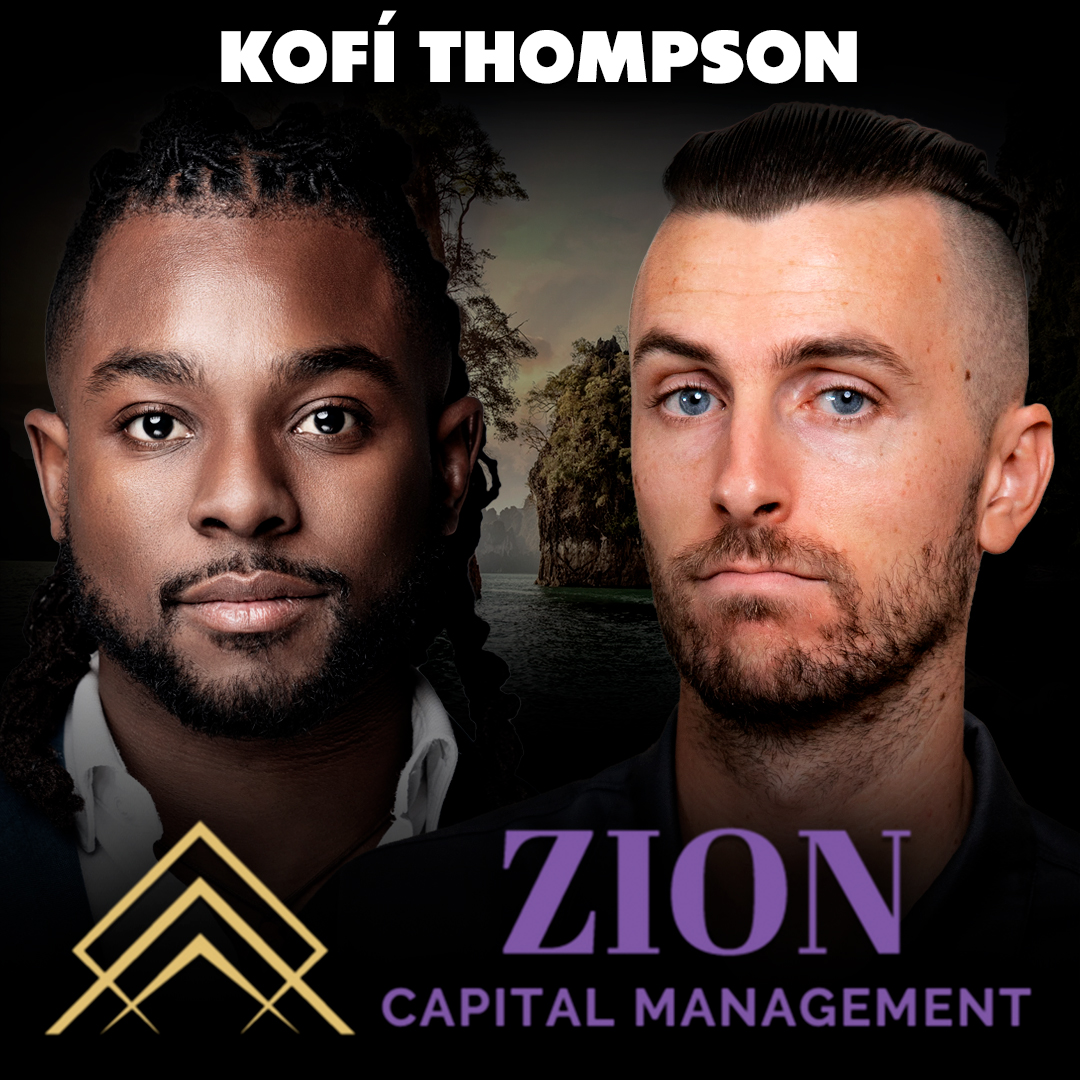
Kofí Thompson is the founder of Zion Capital Management.
Born in upstate New York, Thompson later grew up in Reston, Virginia, which is only 22 miles from Washington, D.C.
During that time, Thompson developed into a talented athlete who often preferred to be a calculated observer instead of a boisterous conversationalist.
“I was a weird mix of shy and outgoing,” Thompson says.
“I knew a lot of people because I played sports, but at the same time, if I didn’t know someone that well, I wouldn’t just go up and talk to them. In that sense, I was an ambivert [blend of extrovert and introvert].”

Post-high school, Thompson enrolled at VCU, a heralded university that is perhaps best known for their March Madness success of recent past.
Due to financial constraints, Thompson spent only one semester at VCU, after which he attended community college for a few years, but for the friendly and well-spoken Thompson, a traditional path simply wasn’t part of his destiny.
“I was originally planning on going into the medical field, but tragedy struck, and my father was diagnosed with terminal cancer, and I started to realize the medical field wouldn’t offer me the service and growth-oriented career path I desired,” Thompson says.
“Later, the opportunity to start my own financial planning practice occurred, and after seeing the lack of options my parents had without proper guidance, I realized this was my calling.”
The term financial planning confounds some individuals, particularly because there are an array of financial services that companies, both reputable and untrustworthy alike, offer to consumers.
For his part, Thompson and his team at Zion Capital Management try to take the guesswork out of financial planning, mitigating the fog by being transparent versus transactional, and taking the extra steps to ensure their clients are adequately informed before making a decision.
“Really helping clients achieve clarity with their finances so that they can be aligned with their financial goals,” Thompson responds with when asked what the objective is when clients sit down for a meeting with him or one of his advisors.
This usually entails offering direction to clients who may be, through no fault of their own, rudderless and in need of proper guidance, something Thompson, with over a decade of experience building expertise in personal finance, and five years of professional experience in financial services, can seamlessly supply.
“I help people work toward their financial goals so that they can realistically accomplish them in the future,” he says, simplicity and brevity evident as he effortlessly makes complex topics like money management palatable for the everyday consumer.
For context, many of Thompson’s clients often come to him without a plan already in place, meaning their efforts toward effective money management ultimately aren’t working.
“A lot of times people are operating inefficiently when it comes to their finances,” Thompson deadpans.
“This includes not properly mitigating their taxes, managing their investments, or equipping themselves with the available tools that are at their disposal.”
In that sense, it is Thompson’s job, and fiduciary responsibility, to develop a viable long-term strategy for his clients, and to do that, he has to do more than just discuss verbose financial topics.
Essentially, he must create for clients a blueprint that they can easily follow.
“It all starts with intentionality,” Thompson says.
“What that looks like in practice is paying yourself first, so before you go and buy a Gucci bag or burn through discretionary income, it’s important that you are funneling money into assets and not liabilities so you can achieve the freedom you deserve.”
This profit-first philosophy is often implemented by business owners looking to revamp the way they manage their cashflow, and it’s this same type of concept that Thompson teaches to his clients.
“You want to be allocating your dollars so that you are building up your personal wealth before you focus too much on other areas of your financial life,” Thompson asserts.
Still, the amount of money each individual or family earns varies, so while saving money is productive, that alone may not lead to long-term financial success, which is why the ambitious Thompson is a huge proponent of developing professional skills in order to increase your marketability, and theoretically, your earning potential.
“And while you’re doing that you still want to be starting early with investing in various types of financial assets, because the earlier you start, the better off you will be later on in life,” Thompson reminds readers who are in that 20–40-year-old demographic.
For clients who are exceeding forty years of age, Thompson advises appropriating more funds to financial instruments like life insurance policies that can protect families from unforeseen tragedies.
“Acquiring the right life insurance policy and building an investment portfolio based off your needs will prevent you from being in the fourth quarter of your life and scrambling to do everything you should have been doing already up to that point,” he says.
If it seems like there is a sense of urgency in Thompson’s voice, that’s because there is, but his words aren’t laced with malice or greedy contempt.
Rather, as someone who has spent virtually his entire adulthood managing money and expectations, Thompson has seen the consequences of both good and poor financial planning.
“I’ve witnessed how much of a difference it makes when you start investing early because after seeing the outcome my parents suffered and meeting hundreds of people in their fifties and sixties who are just starting to have these types of conversations, in many ways they are drastically behind where they should be,” Thompson explains, then making the analogy to one’s health, and how that too can falter prematurely if not effectively managed from a young age.
“People who focus on their health when they are younger as opposed to when they are older and not feeling as good, often down the road they end up being better off.”
Adds Thompson:
“It’s the same thing with finances, but human nature is that we usually don’t focus on things until they become a problem. We are bad at managing, but we are good at fixing. Yet, with money, it’s much easier to manage it than it is to desperately try to fix it.”
To be clear, Thompson is not promoting the idea that people should work tirelessly to become wealthy so that they can avoid future financial pitfalls.
In many ways, one’s income is almost irrelevant, particularly because whether you make $50,000 per year or $500,000 per year, often expenditures only increase as one earns more, which in effect cancels out the increased income that someone may generate.
“As you make more money, your lifestyle shouldn’t outpace your income,” Thompson believes.
“As you start to make more, if you continuously save more and live within your means, then that’s one of the best things that you can do for your long-term financial health.”
These strategies seemingly will bring clients of Zion Capital Management to that hallowed moment where they will retire with little to no financial worries and the freedom to do as they please.
But is getting to that desired endpoint really as glorious as advertised?
In the past, Jerrid Sebesta shared his thoughts on why retirement in itself can be overrated, if not detrimental to the individual(s) wading through their golden years, sentiments that Thompson himself has also echoed.
“I’ve seen cases where people have accumulated all the money they need for retirement, but then they are devoid of purpose, so in addition to the financial aspect of all this I also counsel my clients on their future in retirements,” Thompson mentions.
“The reality is that you can only sit on the beach and drink so many Mojitos before your liver is going to start to hurt and you’re going to be yearning for something to do, so retirement planning, outside of just the financial component, is something I address with my clients as well.”
Ultimately, it’s optionality that Thompson and Zion Capital Management are looking to create for their clients, and again, that doesn’t strictly come down to how much money one possesses.
“Having a surplus of capital and assets equates to freedom. If you think about it, that’s all money really is, so then it becomes a matter of what is one going to do to maximize the optionality that they have created for themselves?” Thompson stresses, albeit rhetorically, before punctuating the importance of having a diversified portfolio, and outlook on life.
“My parents didn’t have options. I grew up in Section 8 housing. My mom would bring Ziploc bags to buffets so that she could bring some food home for us. I mean, we had actual roaches in our cereal.”
Continues Thompson:
“I love my parents, but I didn’t get to experience a lot of the things that my peers did, and I later saw my parents suffer due to a lack of options with their finances. Working off that, I’m taking the steps to achieve financial freedom, and I am also doing what I can to help ensure that our clients get to that point as well.” QS
**
As a family-owned business with 53 years of experience in the Twin Cities market, Grussing Roofing specializes in residential roofing, insurance restoration, siding, windows, and gutters.
For homeowners and commercial building owners who are looking to connect with a company that prides themselves on putting customers first, look no further than Eden Prairie-based Grussing Roofing.
 quentinsuper.com
Leave a comment